

The customer's task
The customer approached us to set up basic control over a work minibus. The main needs: know the exact location of the vehicle in real time, and record mileage and trip history without interfering with the vehicle's fuel system.
The solution
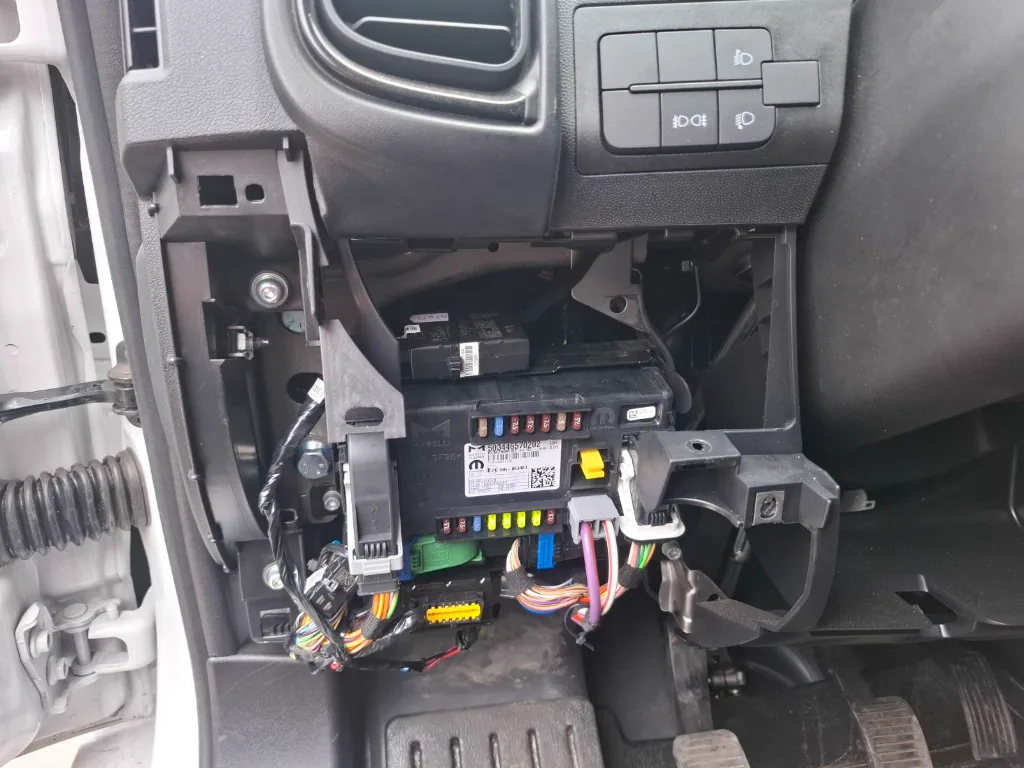
We chose a Teltonika FMB125 GPS tracker. The device was fitted out of sight, behind the dashboard, wired into the basic power circuits. No additional sensors or CAN modules were fitted at this stage — the installation took under an hour, with no long downtime for the vehicle.
Why the FMB125 and not a cheaper model
Let us be straight about it: for the task the customer described at the outset, an FMB920 would have been enough — a smaller, cheaper tracker. It shows location, keeps route history and records speed just the same. The same goes for the FMC920, its 4G version.
The difference is not in what these models can do today, but in what they will be able to do tomorrow. The FMB920 and FMC920 have a far narrower set of inputs for external equipment. The FMB125 has full serial interfaces, and those are what later open up:
- Cabin temperature control — the moment perishable goods enter the picture.
- Reading the CAN bus — real fuel consumption, mileage from the factory odometer, engine RPM, fault codes, tank level.
- Remote engine immobilisation — in case of theft or an unauthorised trip.
- Fuel level sensor, driver ID reader, extra relays — when more control is needed.
The price gap between the FMB920 and the FMB125 is 500 UAH. The gap in consequences, should CAN data or immobilisation be needed a year later, is larger: a different tracker has to be bought, and removal, fitting and configuration paid for a second time. Saving at the start turns into paying twice.
We do not push anyone towards the pricier option where it is genuinely unnecessary: if the task is settled for good, the FMB920 is the right choice, and we will say so. But with a company's working vehicles, needs tend to grow. First it is "just show me where the van is" — six months later it is "how much fuel does it actually burn?".
What the customer got
- Accurate mileage control: waybills are generated automatically, which made it possible to optimise fuel spending against approved consumption rates.
- Route history: the ability to check where the vehicle was at any moment in time (movement archive is kept for up to 365 days).
- Security: instant alerts when the vehicle leaves the permitted geofences, plus recording of driving style (speeding, harsh manoeuvres).
- Fast installation: fitting and configuration took under an hour, with no long downtime for the vehicle.
- Room to grow: any of the functions listed above can be added later — on the same tracker, without replacing it.
This is an entry-level solution for courier services, sales representatives and corporate fleets, where the main goal is to see vehicle movement and keep its use on-purpose. With one difference: it does not hit a ceiling the moment the task gets more demanding.
More about the service: GPS for cars and minibuses