

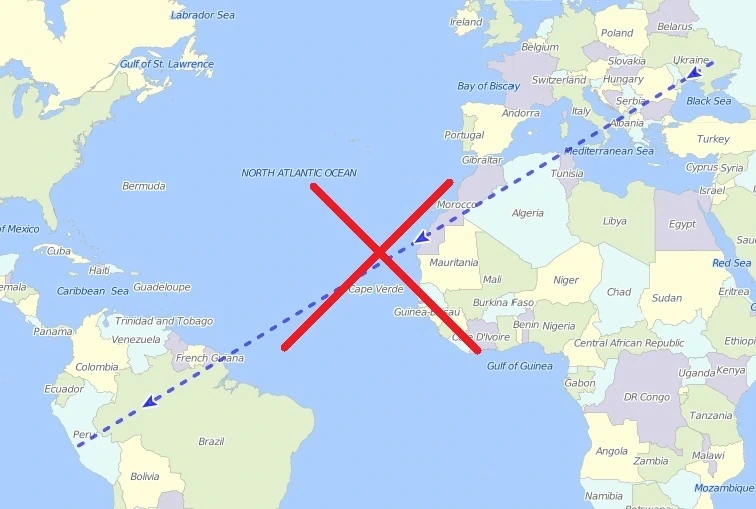
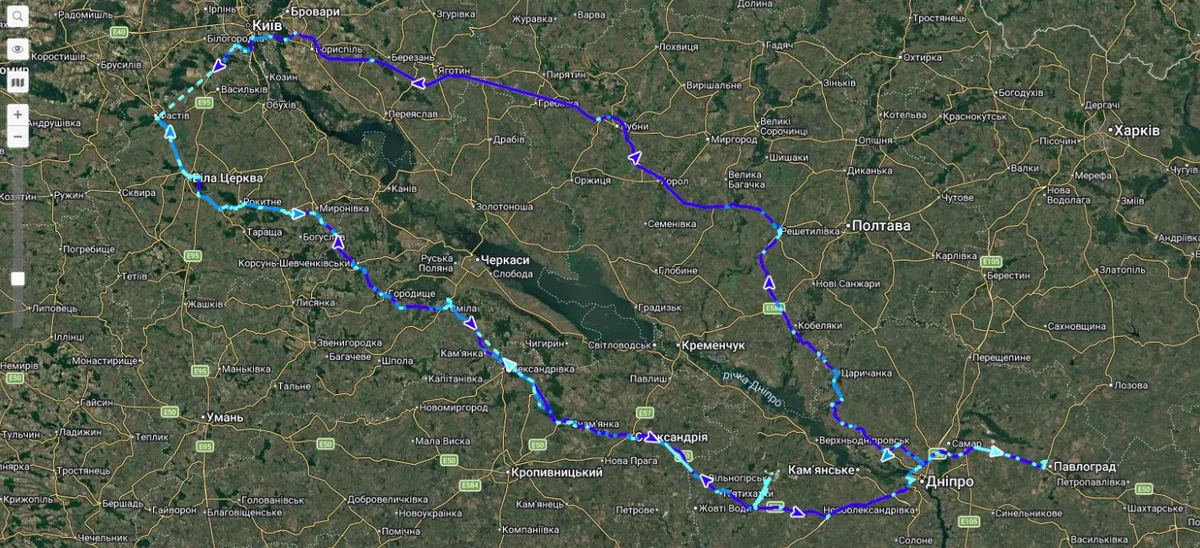
Modern fleet GPS tracking runs into spoofing (coordinate substitution) and signal jamming more and more often. Because of radio interference an object on the map can jump hundreds of kilometres, teleport abroad or show an impossible speed. Those outliers distort mileage, trip reports and fuel control. Our automated track cleaning fixes these artefacts every night — with no manual work from the operator, and without losing a single sensor reading. It is included in the subscription and is not billed separately.
How the nightly algorithm works
A background job (cron) walks the whole fleet in the Wialon platform every night. It analyses every point of the track and tells real movement from spoofing by the physics of the motion — distance, time, speed, satellite count. That is how continental teleports, isolated jumps and the "accordion" pattern caused by jamming are identified.
A false point is not deleted. Its coordinates are replaced with those of the last trustworthy point, while everything else the tracker reported is left untouched: fuel level, temperature, CAN parameters, the state of any additional sensors. On the map the object does not fly across the ocean: it stays on the last trustworthy point until the tracker sees the satellites again. The telemetry for that period does not go anywhere.
That is what matters most: the jammed period can still be analysed. You can see fuel level movement, temperature readings, the operation of an auxiliary heater and other parameters. Had the points simply been deleted, those readings would have gone along with the false coordinates, and that stretch of the trip would have been a blind spot.
A genuine trip abroad the algorithm leaves alone: the physics of the motion tells a real border crossing from a teleport, and the coordinates are not substituted. A null position from the tracker is left untouched too. A backup is created before any change, so the data can always be restored.
A clean track means accurate reports
After processing the route becomes readable: the teleports and the "accordion" are gone and the real path is left. But the gaps in the route remain — where there was no signal, the system does not know where the vehicle actually drove, and it will not draw that stretch in.
That is why the mileage calculation mode in Wialon matters:
- By all messages — neighbouring points are joined by a straight line, so the gap is counted as a straight line too. The mileage comes out closer to the real figure.
- Adjusted — the jumps to Lima are ignored, but so is the gap, even as a straight line. The mileage comes out understated.
So after cleaning we count mileage by all messages: a straight line across the gap is closer to the truth than zero for that stretch. That feeds straight into fuel accounting, driver control and the customer's trust in the monitoring system.
Why online objects sometimes "fly to Lima"
An important nuance: the algorithm runs at night, while the live map shows whatever the tracker is reporting right now. So during spoofing an object can briefly "fly to Lima", and during jamming it can jitter in the "accordion" pattern. You see that online, and in the current day's track, until the next nightly pass runs. After it the history is clean: the coordinates replaced and the sensor readings for that period still in place.
Why Lima, of all places? There is no definitive answer: the military does not comment on how electronic warfare systems work. Open sources have mentioned an EW system named "Lima" that feeds GPS modules the coordinates of Peru instead of the real ones, in order to throw Shahed drones and missiles off course. The side effect is that civilian trackers inside its coverage also "move" to South America. That is exactly the trace you can see in the first screenshot.
What the business gets
- less manual work for the operator;
- reliable mileage and reports, undistorted by spoofing;
- sensor data preserved even during jamming;
- daily automation for a fleet of any size.
Automated track cleaning combines dependable GPS monitoring with the realities of operating under electronic warfare. Your data stays accurate and the system stays manageable.
More about the service: GPS vehicle tracking