

Monitoring farm machinery differs from monitoring a truck so much that road experience barely applies. A truck only needs to know where it is going. A tractor needs to know exactly what area it has worked, with what overlap, and how much fuel that took.
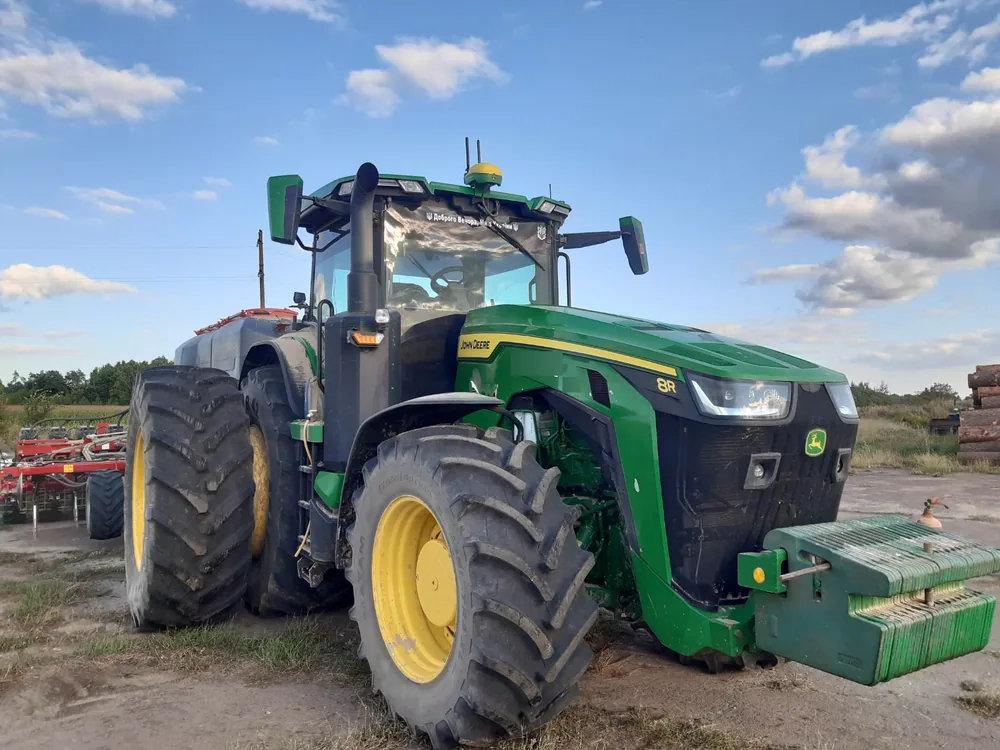
Why the lines in the field come out crooked
The first thing everyone who fits an ordinary tracker to a tractor runs into: the route on the map looks nothing like straight parallel passes — it looks like a shaking line. A field worked out perfectly evenly comes back as a scribble in the report.
The cause is neither the tractor nor the operator. The tracker sits in the cab, often behind a panel or under the seat, where it is out of sight and out of reach. For satellite reception that is the worst possible place: a metal roof, heated glass, cab pillars. The signal arrives reflected, and positioning error grows from a few metres to tens of them.
On the road you never notice it: the track still lands along the road, because the algorithm snaps points to it. In a field there is nothing to snap to — and every metre of error is visible on the map.
Taking the coordinates from the machine's own computer
A modern tractor already has a receiver of its own — and a far better one than the tracker's. It sits on the cab roof, with a large antenna and signal correction, because the autosteer runs on its data. If the machine drives the field straight, it already knows its position accurately.
The logical move is not to measure a second time, but to take what is already there. The receiver broadcasts its position onto the machine's bus in standard messages, and a tracker can read it from there instead of using its own GPS. We fit Bitrek equipment, which handles CAN, and configure it to do exactly that.
The result shows immediately: instead of a shaking line, the report has straight parallel passes — the same ones the autosteer sees. Area is calculated from the real position of the implement, not from the approximate position of the cab.
We match the hardware to the machine. For modern equipment with developed on-board electronics we use the BI 450 TREK — a 4G tracker with a wide set of interfaces, built for complex machines. Where that much headroom is unnecessary, more affordable Bitrek models are enough.
And straight away, honestly, about the limits of this. It does not work out on every machine. What is described above is based on equipment where everything is predictable. But there are many manufacturers and many models, each with its own implementation, and what a particular tractor's on-board computer actually gives up is established on site: by connecting and checking which parameters really arrive on the bus.
So we do not promise this feature in advance, and we do not write it into a quotation as guaranteed. First we look at the machine, and only then say what can be taken from it. If coordinates from the bus are unavailable, the tracker's own GPS remains: worse for the straightness of the lines, but the monitoring does not go away.
Hectares: how much was really worked
A clean track is not a report in itself. The question that has to be answered at the end of a shift is a different one: how many hectares were closed, and on which fields.
For that we connect Hecterra — an application for the Wialon platform built specifically for agriculture. Fields are defined in it as polygons, each implement gets its working width and offset, and from there the system finds the cultivations and calculates the area itself.
Importantly, it does not simply compute "track × width". Hecterra accounts for overlaps and unworked areas inside the field — ponds, pylons, shelterbelts, headlands. That is, the difference between "drove across" and "worked", the one that keeps producing surplus hectares in paper reports.
The output is reports broken down by field, machine, implement and operation, exportable to a spreadsheet. Not "the tractor worked 9 hours", but "field 14, disking, 47 ha, 6% overlap".
Fuel: CAN, a level sensor — or both
There is no single right answer here. We choose the data source for the particular machine — from the tank layout, and from how much accuracy the customer actually wants to see in the reports.
CAN. The factory system already knows the level in the tank and keeps a counter of fuel consumed. This costs nothing beyond the tracker itself: no cutting in, no drilling. Very often it is entirely sufficient.
A fuel level sensor. We fit one when the bus data is missing, or its error is too large for accounting. The reasons are technical: the factory sender has blind zones at the bottom and top of the tank and coarse resolution, and fuel moves about while the machine does — in a field, where equipment works on slopes and rough ground, that is noticeable. A modern level sensor smooths those swings and gives a clean curve, from which you can read actual consumption, averages per hectare and per engine hour, along with overruns and discrepancies between fuel issued and fuel burned.
Both sources together. Also a working option: level from the sensor, and from the bus — engine speed, engine hours, temperatures and the counter. Each source does what it does best.
What exactly to fit is decided on site, once the machine and its tank geometry are visible. We do not push sensors where the bus already gives a good enough picture — and we do not pretend CAN suits everything.
What it adds up to
- Hectares you can show. A calculated coverage map with real overlap — a figure nobody has to assemble by hand at the end of a shift.
- Comparability between machines. When everyone is counted by the same method, it becomes clear who genuinely works more efficiently, rather than who reports better.
- Consumption per hectare, not per kilometre. For field work that is the only figure that means anything.
- Engine hours and idle time. When the engine was running while the machine was not moving — and how much fuel that took.
We do not fit the same solution to everything. A new tractor with autosteer needs no more than a tracker with CAN — it already knows everything about itself. Older machinery without on-board electronics needs sensors of its own, because there is nowhere to take the data from. That is why the selection starts with a list of machines, not with a price list.
More about the service: GPS monitoring for agricultural machinery