

It seems logical enough: the tractor unit already carries a tracker, so why fit a second one — just wire the reefer's sensors into the existing device and be done. On paper it saves money. In practice this is exactly where the trouble starts, and where the job later has to be done again.
When wiring into the tractor unit's tracker works, and when it does not
Bluetooth does work — just not everywhere. If the reefer body has thin walls and the sensor goes on the front wall next to the engine compartment, the link to the tracker in the tractor unit holds. That is a viable setup and we do not dismiss it.
Beyond that the problems begin. The deeper into the body you go, the more metal, insulation and cargo sit between the sensor and the tracker. The signal comes and goes, gaps appear in the report, and nobody can tell whether the sensor failed or simply could not reach.
You can check this before any installation work, using the Eye App. The driver connects from a phone and sees the sensor's readings: temperature, humidity, battery charge. If the signal reaches, the solution is sound. The battery, incidentally, lasts up to five years and can be replaced without help.
Wired equipment needs an extra cable. Running wires from the reefer to the tracker in the tractor unit calls for another ABS cable — or several. And here comes a risk that has nothing to do with the quality of the installation: the driver may mistake the extra cable for the standard one. One wrong connection, and the equipment is destroyed.
As for a fuel level sensor, wiring it this way makes no sense at all. The tractor unit's tracker sees a single object: reefer fuel and tractor fuel add up into one figure, and no one can separate them afterwards. So the sensor is fitted, the money is spent, and the one question that mattered — how much did the reefer itself burn — still has no answer.
Add the plain logistics of it: trailers get hitched to different tractor units. Tie the equipment to one vehicle and the next swap takes everything with it.
The solution: the trailer's own tracker in a sealed box
We fit the reefer with a tracker of its own, and to let it survive life underneath a trailer we put it in an enclosure rated IP67 — IP68 and rubberised where the job calls for it.
There is a non-obvious saving here: buying an ordinary FMB125 plus a box costs less than buying a tracker with factory IP67 protection. The protection ends up the same; the price does not.
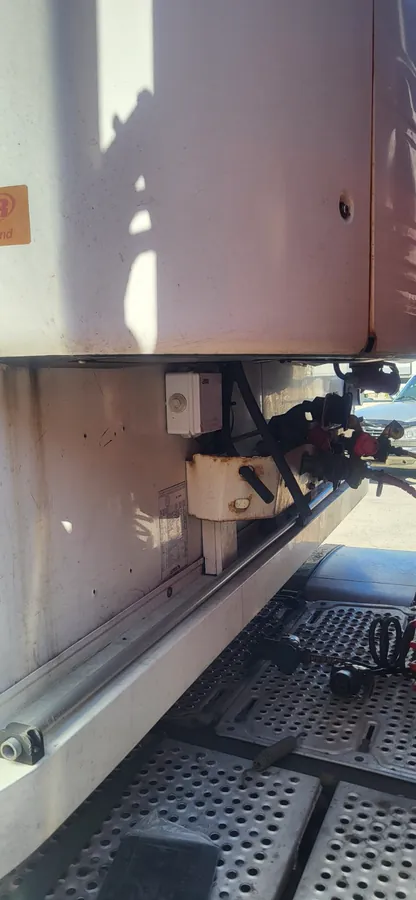
The mounting point is the engine compartment of the refrigeration unit. If there is no space inside, we fix it underneath.
How reliable that is, time has answered: the trackers we fitted this way for our first customer five years ago are still running — and show no sign of stopping. No corrosion, no moisture inside. For equipment that rides through rain, snow and road dirt under a trailer every day, that is the argument that matters.
Reefer fuel as a figure of its own
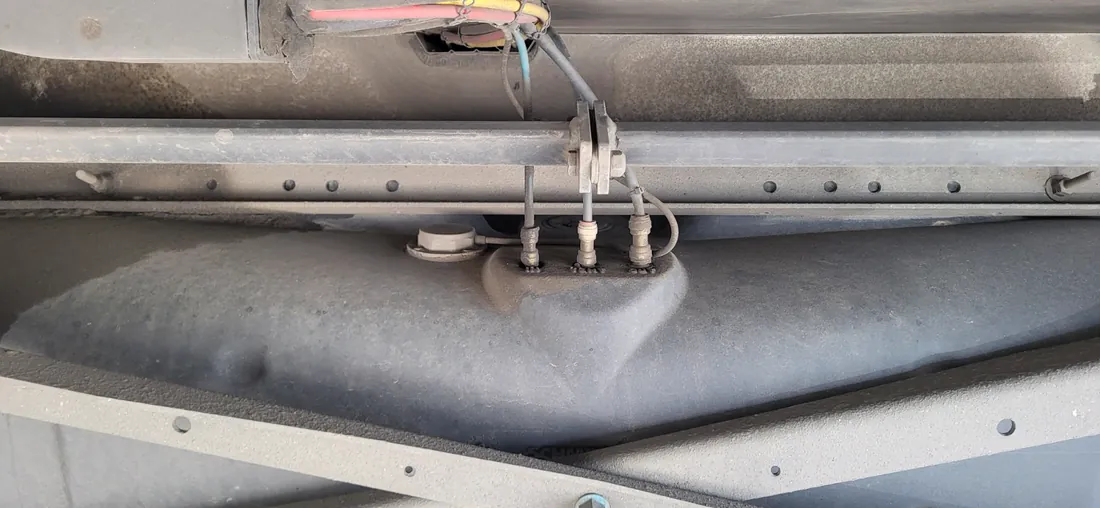
Where the customer wants it, we fit a fuel level sensor in the reefer's tank. That gives you what no arrangement built around the tractor unit's tracker can: in the software the refrigeration unit becomes a separate object with its own consumption.
Here is how that looks in a five-day report — consumption, averages, refuellings and drains for the refrigeration unit alone:
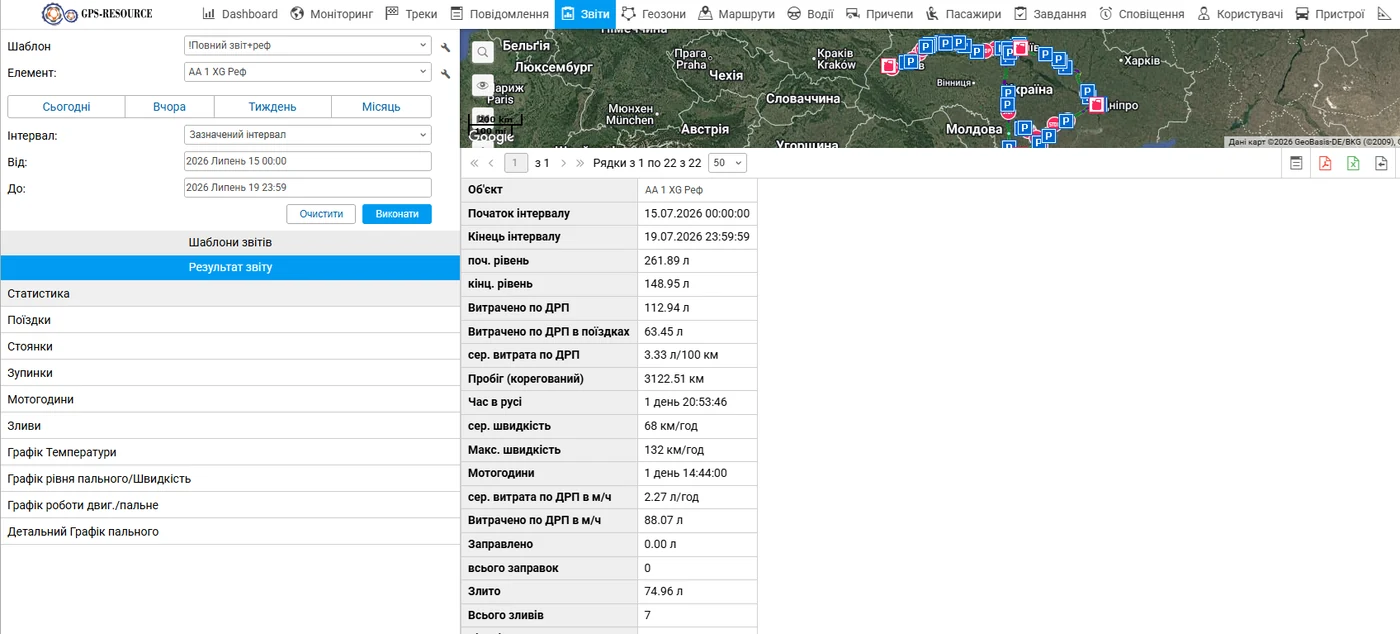
Once the reefer is an object in its own right, you can see both the average consumption per engine hour and every drain from its tank. Inside a combined figure with the tractor unit, all of that would simply dissolve.
But the "drains" figure has to be read together with the graph. The software takes the difference in level between the start and the end of a stop and flags any fall as a drain — including the case where the reefer simply stood with its engine running, burning fuel to hold temperature.
Telling the two apart is not difficult once you look at the shape of the line: a sharp fall is a drain, a slow decline while the engine is running is ordinary consumption. So we never hand the customer a bare number out of the report — we check each case against the graph.
Temperature: up to five points inside
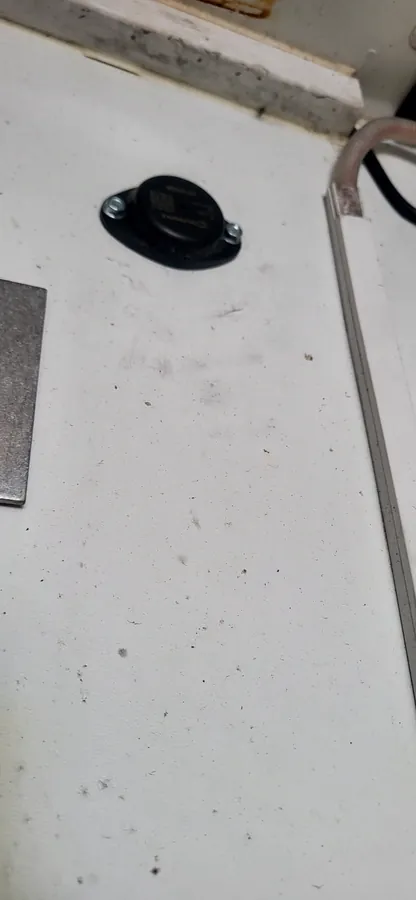
To that same tracker we connect up to five temperature sensors in different parts of the body. One of them can be moved outside, so you can see the ambient temperature and judge the conditions the unit is holding its setpoint in.
The graph reads out the whole trip at a glance: pull-down to setpoint, and operation at different temperatures.
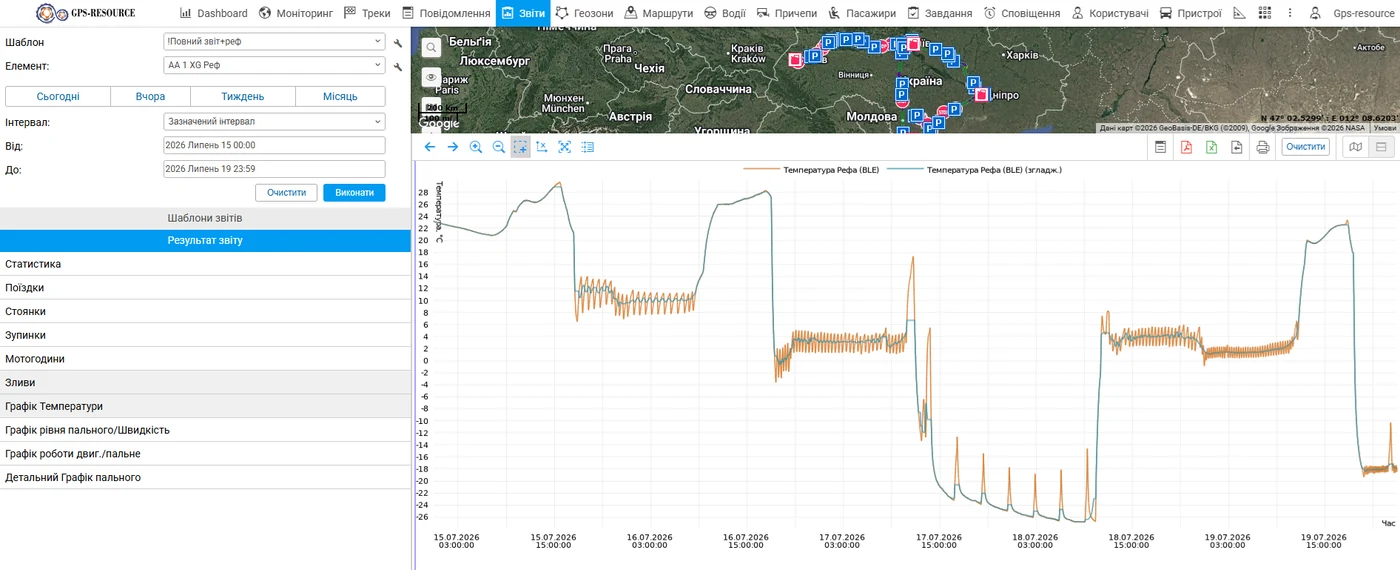
Position and time are recorded alongside the temperature — so any point on the graph can be asked "where was this, and when".
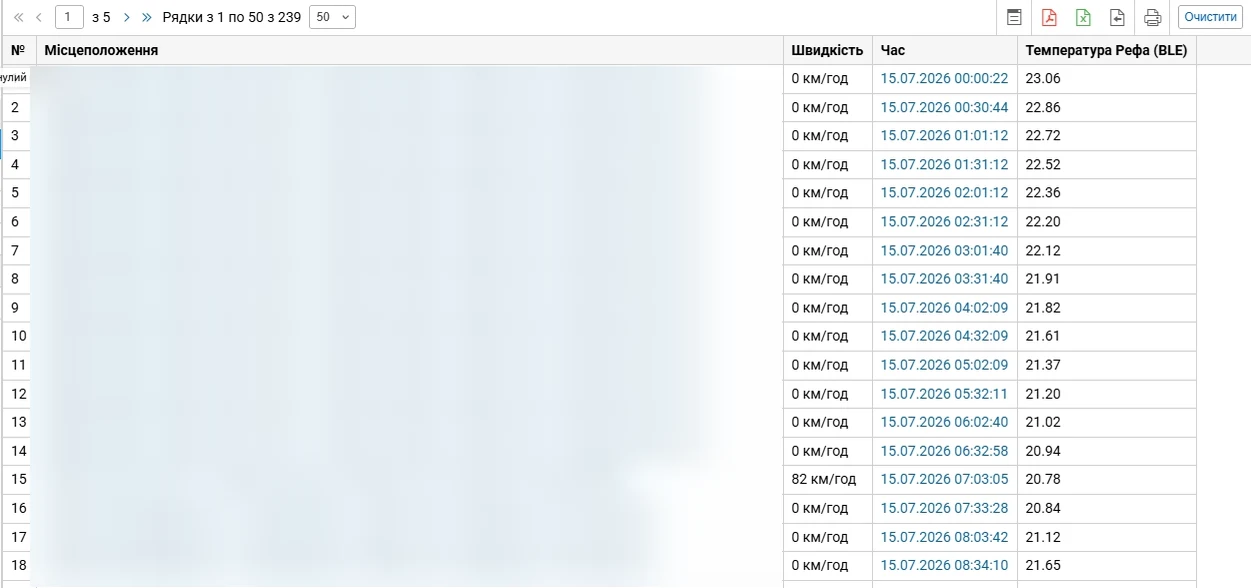
The recording interval is a setting, not a limit. On the screenshot the entries come once every half hour, but the settings allow any interval from one minute upwards.
Worth knowing in advance
One question comes up more often than any other: why do our sensors not show the same figure as the reefer's own controller.
There are two reasons, and neither is a fault:
- The sensors sit in different places. The factory ones are where the unit's manufacturer put them. Ours are where you need to see the temperature, in the part of the body that matters to you. Different points of a body hold different temperatures, and that is normal.
- The reefer's controller may average. It shows a single figure derived from several of its own sensors. Ours show every point separately. We can average ours as well, and still show each point on its own — but even an averaged figure may differ from what the unit reports.
So we do not promise a digit-for-digit match with the factory system. Our job is a different one: an independent measurement at the points that matter to you, with history and a link to the route.
What it changes in practice
More than 50 refrigerated units across different clients run on this scheme. It is the same everywhere, and every figure in the report has its own source:
- Engine hours — from the tracker: how long the unit actually ran.
- Litres — from the fuel level sensor: how much the unit burned over those hours.
- Temperature and humidity — from the temperature sensor: the regime the cargo travelled in.
Real fuel consumption is the most obvious benefit, but not the only one.
Temperature and humidity data you can show the customer. A printout of the regime for the trip can be handed to the cargo owner along with the paperwork — a dedicated reefer printer costs around 700 dollars on its own.
Temperature control during the trip. Not after unloading, when nothing can be changed, but while the vehicle is still moving.
The driver's work changes too. Before the system was fitted he could ignore the temperature regime and siphon fuel — and the haulier discovered the spoiled cargo at unloading, together with the customer. For a haulier that is reputation with the customer, and it drops to zero instantly. With a tracker and the additional equipment, doing it unnoticed is impossible.
So the arithmetic is short: the kit pays for itself in a single trip.
Who needs this
- Carriers of food and pharmaceuticals — when you have to document that the cold chain held for the whole trip.
- Fleets with changing couplings — the trailer stays itself no matter which tractor unit is pulling it today.
- Anyone counting fuel honestly — the reefer's consumption and the tractor unit's are two different figures, and they need to be seen apart.
We do not fit a separate tracker where something simpler will do. But a refrigerated trailer is precisely the case where saving at the start turns into doing the job twice: first the Bluetooth link drops out, then equipment burns from a confused cable, and at the end it turns out the fuel could not be counted anyway.
More about the service: GPS monitoring for trucks and trailers