

Fitting a GPS tracker the classic way means a removed trim panel, hunting for the right circuits, fuses, and an installer working under the dashboard. The Teltonika FMB003 and FMC003 (the 4G version) work differently: they plug into the OBD diagnostic port — the same one a garage uses for its scanner. Power, connectivity and access to the CAN bus all come through a single connector.
The owner fits it — no auto electrician needed
The OBD-II port is present in every passenger car and minibus built from roughly 2001 onwards, and it is almost always within arm's reach of the driver, under the steering column. The tracker simply clicks into it.
This is the real advantage, bigger even than the speed: no installer is required at all. Anyone can manage it — 2 to 15 minutes, and most of that time goes on locating the port itself: on some models it sits in plain view, on others it hides behind a cover or in a recess under the steering wheel.
In practice this means the device can simply be posted anywhere in the country. No engineer call-out, no waiting for a slot, no vehicle downtime — the driver plugs it in on the parking lot.
There is no cutting into the wiring either. That matters on a car still under warranty: any interference with the electrics is an opening for a difficult conversation with the dealer. Here there is nothing to interfere with, and the device comes out just as quickly.
What it actually costs
The device itself is dearer than a basic wired tracker. But the comparison worth making is not between price tags — it is between total cost including labour, and the data you end up with.
| Option | Hardware | Fitting | CAN data |
|---|---|---|---|
| FMB003 — into the OBD port | 2,750 UAH | 2–15 min, do it yourself | yes |
| FMB125 — wired, no CAN | 2,200 UAH | about 30 min, installer | no |
| FMB140 with LV-CAN200 — wired, with CAN | 4,800 UAH | 30 min – 4 h, installer | yes |
Against a basic wired tracker the gap is only 550 UAH, and the fitting labour the OBD option does not need more than covers it. Against a wired setup that also reads CAN, the OBD tracker comes out 2,050 UAH cheaper — and the owner fits it in minutes rather than paying for hours of an installer's time.
All three rows are deliberately 2G devices, so the comparison is like for like. The FMC003 is the same model with 4G, at 4,100 UAH.
What CAN shows, and what it does not
Here is everything an ordinary tracker reports without a CAN connection:

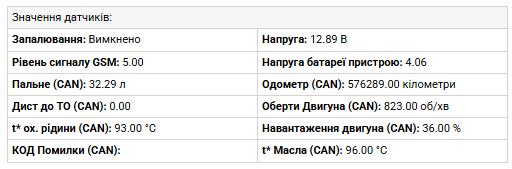
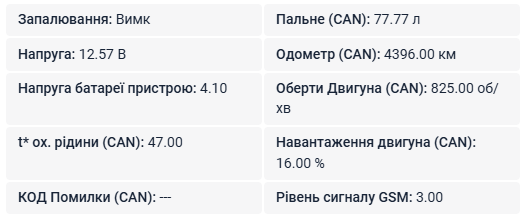
And here is the same vehicle once the tracker reads the CAN bus:
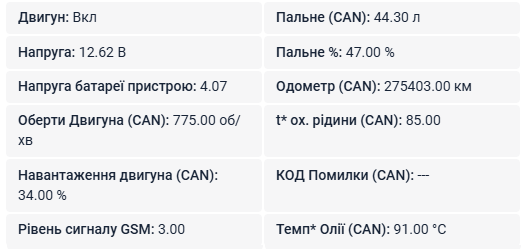
The difference is not cosmetic. Fuel level comes from the car's own sender rather than a separately fitted sensor. Mileage comes from the odometer rather than being calculated from GPS points. Temperatures and fault codes let you catch a problem before it becomes a breakdown.
The odometer does not lie
This is the property that makes CAN worth a conversation of its own.
Suppose a driver decides to use the company vehicle for personal errands and pulls the tracker out of the port. On the map there is silence: the device is offline, there are no points, the report for that stretch is empty.
But the moment the tracker goes back in, it reads the current odometer value off the CAN bus. And that value does not match the one recorded when power was lost. The difference is precisely the distance driven around the system. The vehicle itself reports what someone tried to hide.
A tracker without CAN cannot do this: it counts mileage from its own GPS points, and with no points there is no mileage.
And a concealed installation does not save you here
It may look as though a wired tracker behind the trim is better protected: it is out of sight, and there is no plug to pull. In practice nobody needs to reach it — cutting the power wire is enough. Drive as you please, splice it back when it matters again.
We do seal the splice points. But be honest: who climbs under the dashboard on a regular basis to inspect seals?
The difference is not how hard the tracker is to disable, but whether disabling it leaves a trace. A wired unit without CAN simply resumes counting once power returns, as if nothing happened. One that reads the odometer shows the gap in the figures — and needs no seals to do it.
Why this matters right now
In wartime the satellite signal has stopped being dependable. Electronic warfare systems jam and spoof GPS across whole districts: coordinates jump, disappear, or place a vehicle hundreds of kilometres away. We covered this in detail in our article on cleaning GPS tracks.
For mileage calculated from GPS points, that is fatal: jam the signal and the figure is either lost or inflated by false jumps. An odometer read off the CAN bus has nothing to do with satellites. The car counts it, and no jammer touches it.
The same goes for fuel: the level from the factory sender arrives over the bus regardless of what is happening in the sky.
Two weak spots, and what we do about them
First: the tracker is visible and easy to pull out
Let us be straight: the very simplicity that makes fitting a one-minute job makes removal a one-minute job too. A tracker in the diagnostic port is visible, and it can be pulled out in two seconds with no tools. A wired unit hidden behind the trim is not so easy to reach.
So rather than pretend the problem does not exist, we configure a response to it:
- Power-loss alerts. The moment supply voltage on the tracker drops to zero, the manager gets a notification — in the mobile app and in the web interface. Not in tomorrow's report: immediately.
- The odometer discrepancy. Even if nobody acts on the alert, putting the tracker back reveals the kilometres driven meanwhile.
Together these give you a simple outcome: unplugging the tracker is possible, doing it unnoticed is not.
Second: roughly 1% of cars give no data
On about 1% of the vehicles we have fitted, the CAN data did not come through — or only part of it did. This is not a fault in the tracker, nor a connection error.
The cause sits in the car itself: since 2018 some manufacturers place a protective module between the diagnostic port and the internal bus that only lets dealer equipment through. On top of that, every marque reports a slightly different data set, and the tracker maker adds support for new models gradually, with firmware updates.
Checking takes minutes and costs nothing: plug the tracker in and you immediately see which parameters arrive. If the ones you need are missing:
- We refund you. Our own policy: we take the device back within 14 days, provided it has kept its as-new condition and presentation.
- Or leave it plugged in. Position, routes and speed work either way, and the CAN data may appear with the next firmware update.
- Or we swap it for a wired tracker with a separate CAN adapter.
Who it suits
- Cars under warranty — no interference with the wiring whatsoever.
- Rented and leased vehicles — when the car goes back, the tracker comes out without a trace.
- Mixed fleets — moving the device from one vehicle to another takes minutes and no call-out.
- Vehicles far from the city — we post the device, the driver plugs it in. No need to bring the vehicle in or wait for an engineer.
- Anyone who wants to try first — plugging it in costs nothing, and if no data comes through we take the device back.
- Anyone who needs data, not just a dot on a map — real fuel consumption, engine hours, fault codes.
A wired tracker remains the better choice wherever the point is that it should not be found: theft protection, or working with staff you have reason to doubt. We match the solution to the task rather than the other way round — and if a concealed installation is right for your case, we will say so.
More about the service: GPS for cars and minibuses